Introduction
Imagine a time long before the dinosaurs, over 400 million years ago, when the world’s oceans were filled with strange, tiny creatures living together in vast colonies. These creatures, known as graptolites, were so abundant and evolved so rapidly that they became the ultimate timekeepers for geologists, helping us piece together the complex timeline of our planet’s ancient past. Their fossils, often appearing as delicate, saw-toothed marks on dark rocks, are more than just ancient remains—they are the very “pencil writings” that have unlocked the secrets of the Paleozoic Era. The name “graptolite” itself is derived from the Greek words for “writing on the rocks,” a fitting description for these carbonized impressions that look like ancient script etched into stone . This comprehensive article will delve into the fascinating world of graptolites, exploring their biology, their role as index fossils, their evolutionary journey, and their profound significance in modern geology.
The Biology of Graptolites: More Than Just Marks on a Rock
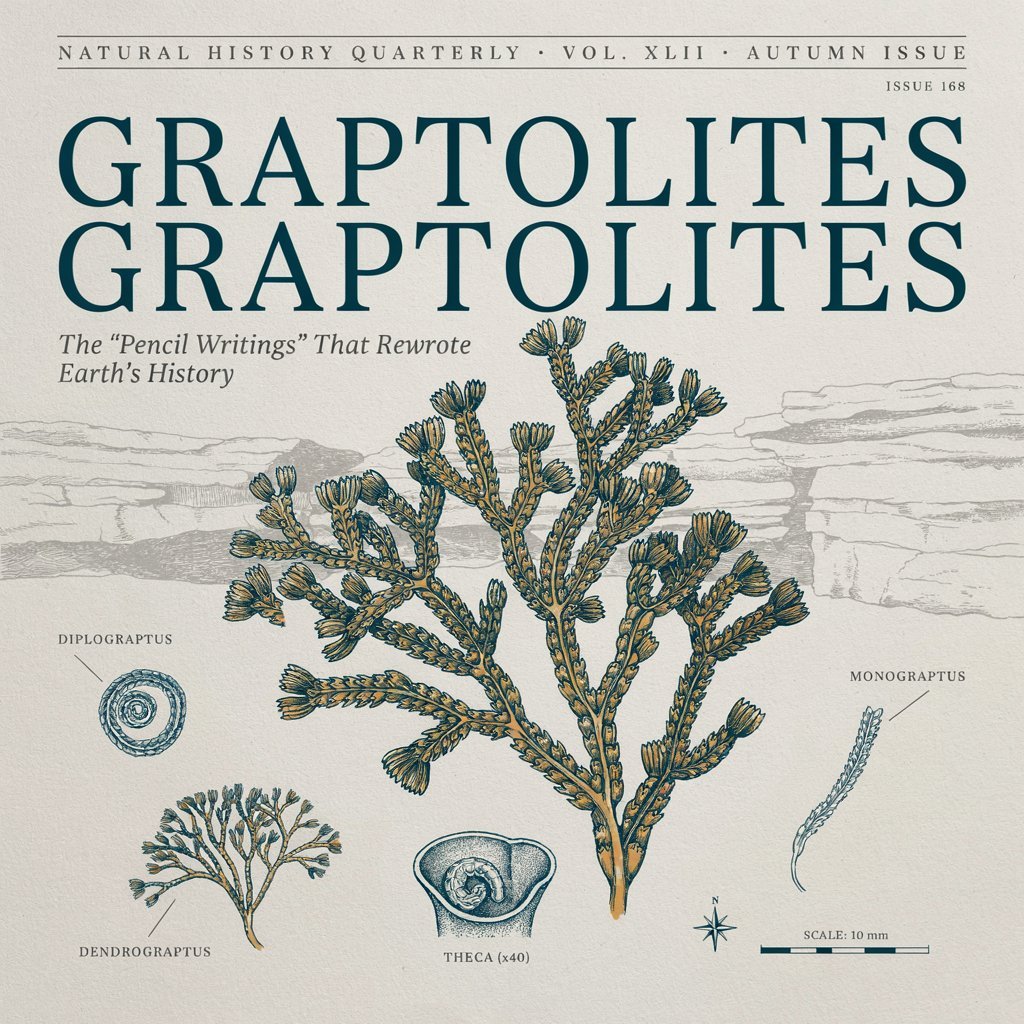
Graptolites were not plants or simple scratches; they were marine colonial animals belonging to the subclass Graptolithina within the class Pterobranchia of the phylum Hemichordata . Each colony was composed of numerous nearly identical individuals called zooids, which were housed in tubular or cup-like structures known as thecae . These thecae were arranged along one or more branches, called stipes, which together formed the complete colony, or rhabdosome . The colonies displayed a remarkable variety of shapes, ranging from shrub-like forms with many branches to simple forms with a single, curved branch . The zooids were bilaterally symmetrical, tentacled animals that were suspension feeders, filtering tiny food particles from the surrounding seawater . The entire colony was constructed from a chitinous (fingernail-like) protein exoskeleton, which is what is typically preserved in the fossil record .
Most graptolites were planktonic, meaning they drifted freely in the ocean currents, though some of the earliest forms were benthic, living attached to the seafloor by a root-like base . For a long time, graptolites were thought to be entirely extinct, but a remarkable discovery revealed that a group of modern deep-sea colonial filter-feeders called pterobranchs are, in fact, living graptolites . This discovery has provided invaluable insight into their biology and ecological role in ancient oceans.
The Fossil Record and Preservation
The fossil record of graptolites is extensive, spanning from the Middle Cambrian period all the way to the Carboniferous, approximately 542 to 318 million years ago . They reached their peak diversity during the Ordovician and Silurian periods . They are most commonly preserved as carbonaceous impressions in dark-colored mudstones and shales, appearing as shiny, pencil-like markings, which is how they got their name . The absence of mineralized hard parts means they are usually preserved as flattened carbon films, and much of the fine detail of their three-dimensional structure can be lost . However, in some exceptional cases, they can be found in a more uncompressed state in limestones or pyritized, preserving their intricate morphology .
Graptolites as Index Fossils: The Geologist’s Best Tool
Graptolites are celebrated as one of the most important groups of index fossils for dating Lower Paleozoic rocks. An index fossil is a species that is widespread geographically but existed for a relatively short period of geologic time, allowing paleontologists to determine the age of the rock layers in which they are found . Graptolites are particularly well-suited for this role for several reasons. They underwent very rapid evolution, meaning different species appeared and disappeared at a fast pace, providing a high-resolution timeline . Additionally, the planktonic species were geographically widespread, allowing for the correlation of rock layers across different continents .
These key characteristics—their abundance in the fossil record, their global distribution, and their rapid evolution—make them the best, and often the only, fossil group for dating Lower Paleozoic rock successions with precision . As many as 42 graptolite biozones have been defined for the Silurian System alone, allowing geologists to correlate strata within time spans of one million years or less . Paleontologist Bill Berry’s work in the 20th century was pivotal in this regard; by studying graptolite fossils, he discovered that certain species were confined to specific rock layers, which allowed him to define new sub-units of geologic time within the Silurian Period . This work fundamentally changed how geologists understand and subdivide this critical era in Earth’s history.
Evolution and Morphological Change
The evolutionary history of graptolites is written in the changing morphology of their colonies over millions of years, a testament to the power of natural selection in a changing environment. The earliest graptolites (Order Dendroidea) were benthic forms that appeared in the Cambrian, with many-branched colonies attached to the seafloor . A major evolutionary shift occurred in the Ordovician when graptolites transitioned from a benthic to a planktonic lifestyle, leading to the rise of the Order Graptoloidea . This adaptation to open-water living allowed them to become widespread and abundant in ancient seas.
The morphology of graptolites evolved in a clear directional trend over time, making them excellent markers for specific geologic periods. In the Early Ordovician, graptolites were characterized by multiple stipes, with genera like Tetragraptus having four branches . This number progressively decreased, and by the later Ordovician, two-stiped forms like Didymograptus became common . Their arrangement also shifted. Early forms had their thecae (the “teeth” or “sawtooth” faces) facing each other, a condition described as “pendent.” Later Ordovician forms had a more open or oblique angle between the stipes. Finally, during the Silurian period, graptolites had their thecae back-to-back (“scandent”), or, in the case of the highly successful genus Monograptus, they had lost one stipe altogether, forming a single-branched colony . These morphological changes, such as the spiral shape seen in some forms, were likely adaptations for more efficient feeding and to prevent sinking . The study of these evolutionary trends, enhanced by modern techniques like SEM (Scanning Electron Microscopy), has allowed paleontologists to build a highly detailed and reliable biostratigraphic framework .
Conclusion
Graptolites are far more than ancient, pencil-like fossils. They are the indispensable timekeepers of the Paleozoic, a group of animals whose rapid evolution and global distribution have provided geologists with an unparalleled tool for deciphering Earth’s history. Their journey from bottom-dwelling colonial organisms to free-floating pioneers of the open ocean represents a remarkable evolutionary story, captured in the changing shapes and forms of their delicate skeletons. From the pioneering work of scientists like Bill Berry to modern research using advanced technology, graptolites have continuously refined our understanding of geologic time, plate tectonics, and ancient ecosystems. The fact that their living relatives, the pterobranchs, still exist in our oceans today bridges a gap of hundreds of millions of years, connecting the deep past with the present. These “writings on the rocks” are a testament to the power of the fossil record, showing that even the smallest and most delicate of creatures can have an enormous impact on our understanding of the world.
Frequently Asked Questions (FAQs)
1. What are graptolites?
Graptolites are an extinct group of tiny, colonial, marine animals that lived during the Paleozoic Era. They are named for their fossilized remains, which look like pencil markings or scratch marks on rocks . These fossils are the preserved skeletons of colonies that housed hundreds of tiny animals called zooids.
2. When did graptolites live?
Graptolites first appeared during the Middle Cambrian period (around 542 million years ago) and persisted until the Carboniferous period (around 318 million years ago) . They reached their peak abundance and diversity during the Ordovician and Silurian periods.
3. Why are graptolites important to geologists?
Graptolites are among the most important “index fossils” for the Lower Paleozoic Era . Because they evolved very quickly and were found worldwide, they allow geologists to accurately determine the age of rock layers and correlate rocks from different parts of the globe .
4. What did graptolites look like?
Graptolite colonies varied in shape. They could be shrub-like with many branches, have only two branches, or even a single branch that was sometimes straight, curved, or spiral-shaped . The edges of their branches have a saw-tooth appearance, which are the individual cups (thecae) where the tiny animals lived .
5. How are graptolites preserved as fossils?
Graptolites are usually preserved as carbonaceous films on the bedding planes of dark-colored mudstones and shales . The lack of mineralized hard parts means they are often flattened, but in rare cases, they can be found in three dimensions in limestones or through the process of pyritization .
6. Did any graptolites survive to the present day?
For a long time, it was thought all graptolites were extinct. However, scientists have discovered that a group of modern, deep-sea, colonial animals called pterobranchs are actually living members of the graptolite group . This has been confirmed through studies of their structure and biology.
7. What is the difference between dendroid and graptoloid graptolites?
Dendroid graptolites are the more primitive, older forms that were benthic (bottom-dwelling). They had many branches and attached to the seafloor. Graptoloid graptolites are the more derived, planktonic (floating) forms that evolved later. They typically had fewer branches and became widespread in the oceans of the Ordovician and Silurian .